

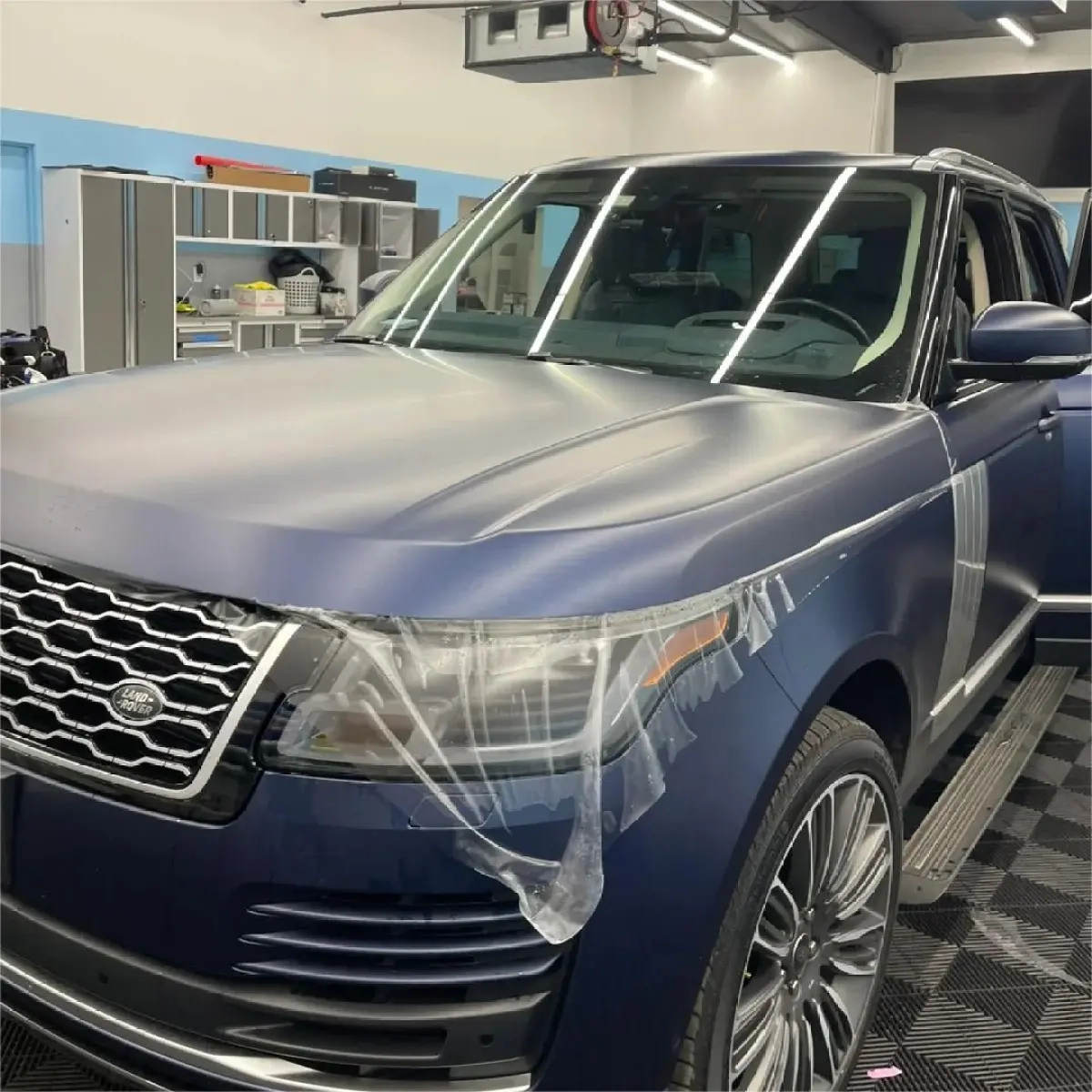
If you’re booking car ppf for the first time, this guide walks you through the exact steps a professional shop follows—from surface prep and pattern cutting to squeegee work, edge-sealing, and post-install care. We’ll also share representative, measured benchmarks from leading technical data sheets so you know what “good” performance looks like in the real world. For shoppers comparing options, remember that vinyl wrap is primarily for color and style, while clear ppf (aliphatic TPU) is engineered for impact resistance, self-healing and long-term paint preservation.
What to Expect on Installation Day
- Vehicle inspection & consultation. Your installer checks paint condition (chips, swirls, repainted areas) and confirms coverage (bumper, full-front, full-body) and film finish (gloss, matte or colored ppf accents).
- Decontamination & prep. Foam wash, iron remover and clay to ensure a surgically clean surface. Light machine polishing may be recommended to remove wash marring before sealing it under film.
- Patterning & trimming. Most panels are cut from a digital pattern (plotter) for precise fit; complex areas (badges, inner edges) are hand-relieved and wrapped where appropriate.
- Wet install. Film is floated on a slip solution, positioned, then progressively squeegeed to expel solution and air. Tack solution is used for tight radii and edges.
- Edges & heat setting. Gentle heat locks edges, contours, and recessed areas. Excess water bubbles typically dissipate during early cure.
- Initial cure & QC. Panels rest while the adhesive builds. A final inspection addresses seams, lift points, and contamination specks before hand-off.
Aftercare Timeline
- 0–24 hours: Avoid touching edges; keep the vehicle dry while initial adhesion builds.
- 48–72 hours: Most brands recommend waiting at least 48–72 hours before your first wash (see brand specifics below).
- 1–3 weeks: Full cosmetic “settle” occurs as micro-moisture evaporates. Light edge hazing or tiny bubbles usually resolve on their own.
If you want a cosmetic change rather than invisible protection, explore a style-forward tpu wrap with a matte look, or stick with high-clarity clear ppf for stealth protection that virtually disappears.
Benchmarks & Measured Values (Representative)
Below are typical, measured properties published in leading manufacturers’ technical data sheets. Use them as a reality check when comparing films:
| Metric | Representative Value | Test Method | Example Source |
|---|---|---|---|
| Total thickness (with adhesive) | ~8.0–8.5 mil (some series up to 10 mil) | Micrometer | 3M Pro Series; SunTek Ultra; XPEL Ultimate Plus 10 |
| Tensile strength | ≥20 MPa (≈2,900 psi) to ~8,200 psi (series-dependent) | ASTM D882 | Global PPF; MaxPro PPF |
| Elongation at break | ~250%–450% | ASTM D882 | 3M Pro Series; Global PPF; MaxPro PPF |
| Adhesion (24 h) | ~4.5 lb/in (7.9 N/cm) | 3M internal | 3M Pro Series 200 Matte TDS |
| Gloss @ 60° (gloss films) | >85 GU typical; premium films >95 GU | ASTM D523 | Global PPF; manufacturer specs |
| Warranty term | Up to 10 years (brand-specific) | — | SunTek Ultra |
Numbers above are representative of modern TPU PPF systems and vary by series and finish. Always compare like-for-like (thickness, top-coat chemistry, warranty, optical clarity).
Brand-Specific Washing Window
As a rule of thumb, wait at least 48–72 hours before washing: some brands advise ~48 h, others recommend ~72 h or even 3 days. Follow your installer’s guidance for your exact film and climate.
Choosing Finish & Coverage
For invisible protection, stick with clear ppf. If you want a satin look without paintwork, a matte-texture tpu wrap creates a uniform finish. Trend-forward builds can mix stealth protection with color accents using colored ppf. For style projects beyond protection, explore a full vinyl wrap program.
Blog comments
0 Comments