

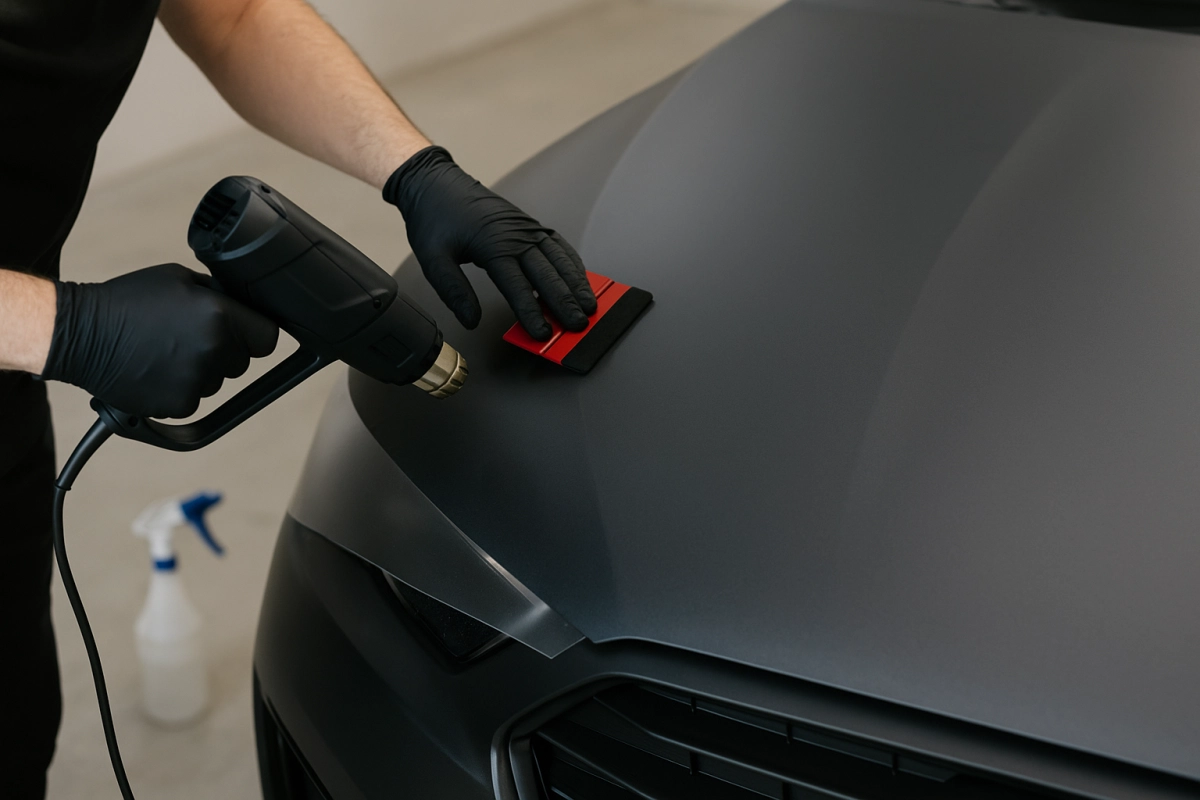
Matte paint protection film (PPF) gives paint a refined satin sheen while guarding against chips, road rash, and marring. Modern PPF is an aliphatic TPU wrap with a self-healing topcoat; most mainstream systems are ~7.6–8.0 mil with adhesive, available in matte or gloss. 3M lists Pro Series 200 at ~7.8 mil and recommends application at 60–85 °F (optimal 70–79 °F).
If your goal is primarily visual customization, a classic vinyl wrap can be ideal; if you want impact resistance plus a satin look, a matte PPF wrap is the premium route. XPEL’s technical sheet, for example, specifies ~192 µm (~7.6 mil) and a self-healing elastomeric clearcoat.
1) Workspace & Panel Preparation
- Environment: Work indoors at 70–79 °F (21–26 °C) when possible; this range improves positioning, adhesive flow, and edge sealing.
- Wash & decontaminate: Foam, two-bucket hand wash, iron remover as needed, then clay bar. Blow out seams and allow panels to dry fully.
- Degrease: Final wipe with 70% IPA (edges and high-tension zones). Avoid silicone residue and dressing overspray.
- Ceramic coating check: 3M warns that existing coatings can hinder adhesion; remove or polish down before film.
2) Solutions & Tools: Slip vs. Tack
Most systems use two fluids: a “slip” solution to float/position the film, and a “tack” solution to lock anchors and edges. 3M’s current guidance emphasizes using less baby-shampoo/mild detergent in slip solution than older recipes.
- Slip: Filtered water + small amount of mild surfactant. Adjust for temperature/humidity—warmer rooms often need slightly “drier” mixes.
- Tack: Water + isopropyl alcohol for anchor points, body lines, and edges. Apply heat cautiously to relax tension on complex curves.
- Tools: Soft-edge squeegee with felt, low-lint towels, heat gun, spray bottles with fine mist, knifeless tape, steamer (optional).
3) Application Steps (Matte-Finish Specific)
- Wet out both sides. Generously mist panel and adhesive side with slip to avoid immediate grab. Keep adhesive clean.
- Set an anchor. Use tack solution to lock a straight reference edge; hold for ~10 seconds on difficult curves before squeegeeing.
- Squeegee in lanes. From the anchor, make overlapping strokes to expel solution/air. Avoid over-stretching matte films (over-tension can cause sheen variation).
- Heat & relax. Warm high-tension areas to relieve stress before setting edges and recessed channels.
- Edges & tucks. Convert to tack solution for edges, badge pockets, and panel ends. Re-squeegee seams after 10–15 minutes to catch late bleed-out.
4) Curing & First 72 Hours
- No washing initially: XPEL recommends waiting at least 48 hours before washing; some brands advise ~3 days to allow full adhesion/cure.
- Edge care: Avoid high-pressure washers near film seams; STEK advises keeping the nozzle ~36″ from the surface and not blasting edges directly.
- Bubble check: Small “silvering” may settle as moisture evaporates. Re-squeegee stubborn areas after a gentle warm-up.
5) Long-Term Maintenance
- Wash method: Hand-wash with pH-neutral soap; avoid abrasive pads and petro-solvent waxes (naphtha/kerosene).
- Self-healing: Many TPU films use elastomeric topcoats; light swirls can diminish with engine/sun warmth or gentle heat.
- Decon: Use dedicated PPF cleaners/sealants; if you top-coat, test on a small area first to ensure it doesn’t mute the matte texture.
6) QC & Troubleshooting
For shop-level quality checks, the adhesion of coatings on metal substrates is often assessed via ASTM D3359 (cross-hatch tape test). While designed for coatings—not films—you can use it on sample test panels to benchmark prep quality (scores 4B–5B are typically “good”).
7) Choosing Your Finish
Prefer a stealth look with chip resistance? Choose a matte PPF wrap. Want a deep wet-look while keeping OEM gloss? Go with clear gloss PPF. Either way, select a high-quality aliphatic TPU with reputable warranty coverage and install within the recommended temperature window.
Related Reading on AlukoVinyl
- vinyl wrap — color change options, film classes, finishes
- TPU wrap — protective films overview and use cases
- clear gloss ppf — ultra-gloss, self-healing protective film
- matte ppf wrap — satin finish with impact resistance
Blog comments
0 Comments