

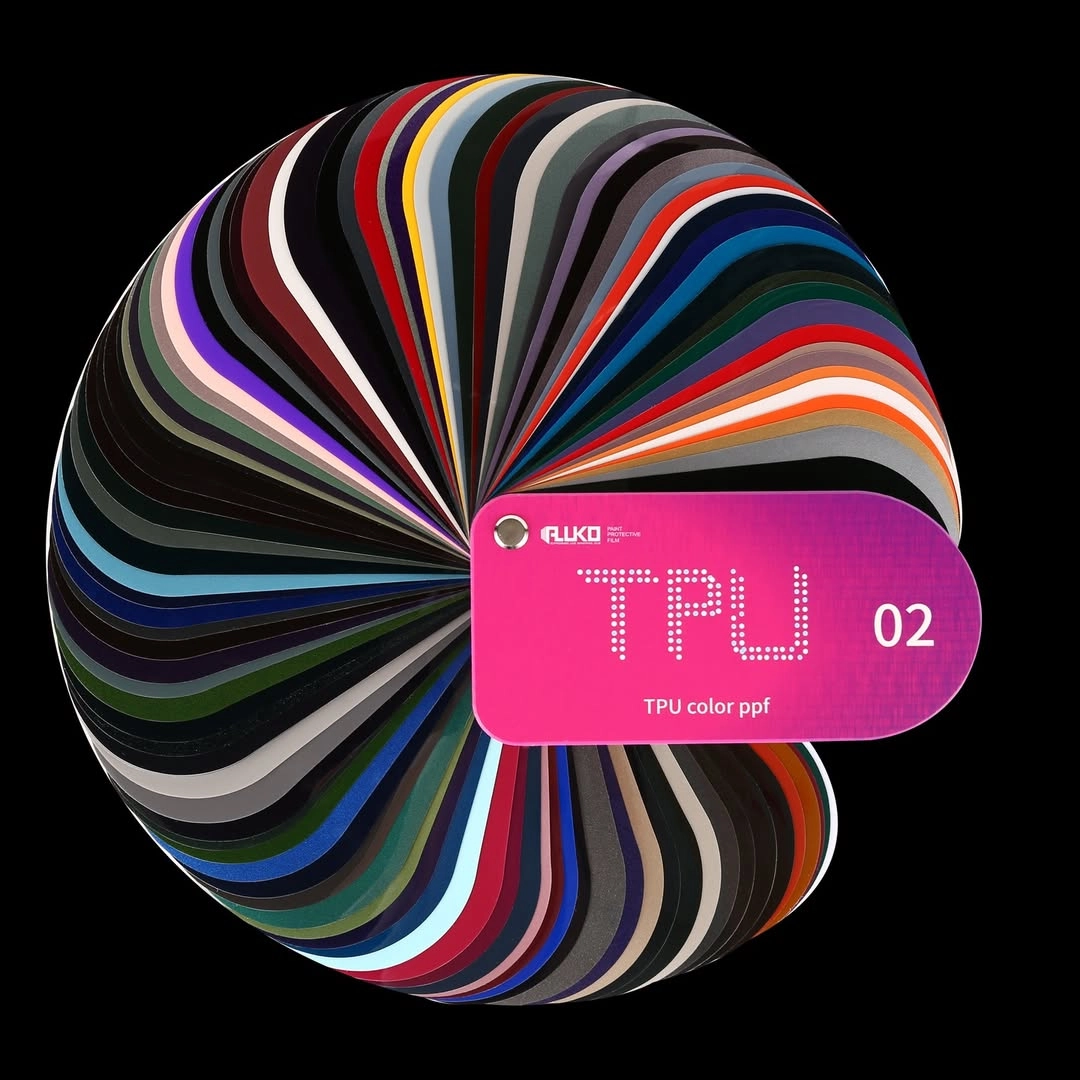
What “TPU Vinyl Wrap” Really Means
In the market, people often say “tpu vinyl wrap,” but what they really mean is aliphatic TPU paint protection film (PPF). TPU PPF is a transparent (or colored) polyurethane laminate with a self-healing, hydrophobic top coat that absorbs chips, abrasion, and UV better than traditional PVC/TPH films. Multiple OEM and aftermarket data sheets standardize performance using tests like ASTM D882 (tensile/elongation), ASTM D1003 (haze/clarity), and ISO 4892-2 (xenon-arc weathering).
Why TPU Outperforms PVC/TPH
- Elasticity & conformability: TPU conforms over complex curves with fewer lift lines and better recovery after stretching.
- Self-healing: Light marring heals with engine/sun heat or warm water—explicitly documented by leading brands.
- Yellowing resistance: TPU PPF maintains clarity far better than PVC; yellowness is quantified via ASTM E313/ASTM D1925 on many TDS.
- Weathering durability: Xenon-arc protocols (ISO 4892-2) simulate UV + moisture for realistic aging comparisons.
ALUKO at a Glance (Transparent TPU PPF)
ALUKO’s clear gloss TPU PPF (Gloss PPF Ultra) publishes hard numbers that matter to installers and owners:
- Total thickness: 8.5 mil (±0.3)
- Base TPU: Covestro; adhesive: Ashland acrylic PSA
- UV resistance: ~98.5%
- Gloss (60°): ~94 GU
- Top-coat: hydrophobic + self-healing
These specs position ALUKO squarely in the premium 8–9 mil class that balances optical clarity with impact absorption.
Quantitative Benchmarks & How to Read Them
Haze/Clarity (ASTM D1003): Lower haze indicates better optical clarity—important on white/black paint and on matte finishes where uniformity matters.
Tensile & Elongation (ASTM D882): Tensile strength (MPa) and % elongation indicate how a film stretches around mirrors/valances and resists tearing at edges.
Weathering (ISO 4892-2): Xenon-arc exposure correlates with long-term gloss retention/yellowing in sun-intense climates.
Example published values in TPU PPF: STEK DYNOshield lists ~6,500 psi (~44.8 MPa) tensile and ~450% elongation (ASTM D412 rubber method); XPEL ULTIMATE PLUS lists tensile >18 MPa and elongation >250% (ASTM D882). Methods differ (D412 vs D882), so compare directionally rather than 1:1.
Brand Comparison (ALUKO vs XPEL, 3M, SunTek, STEK, Avery)
| Brand & Line | Material | Thickness | Tensile / Elongation | Self-healing / Hydrophobic | Warranty | Source |
|---|---|---|---|---|---|---|
| ALUKO Gloss PPF Ultra | Aliphatic TPU (Covestro) + Ashland PSA | 8.5 mil (±0.3) | — / — (not on page) | Yes / Yes | By line; confirm on product page | ALUKO spec |
| XPEL ULTIMATE PLUS 10 | Aliphatic TPU | 10 mil | >18 MPa / >250% | Yes / Yes | 10 years (limited) | TDS; warranty |
| 3M Scotchgard Pro Series 200 (Gloss) | Polyurethane (PU) | 7.9 mil (film+adhesive) | — / — | Yes / Hydrophobic | 10 years (limited) | TDS; product; warranty |
| SunTek PPF Ultra | Aliphatic TPU | ~8–8.5 mil (variant dependent) | — / — | Yes / HydroResist™ | 10 years (limited) | official; spec (reseller) |
| STEK DYNOshield | Aliphatic TPU | 8 mil | ~6,500 psi / ~450%* | Yes / HYDROphobe® | 10 years (limited) | spec; TDS* |
| Avery Dennison Supreme PPF Xtreme (Matte/Satin) | Aliphatic PU | 160 µm (~6.3 mil) film | — / — | Self-healing top coat | Up to 10 years | PDS; overview |
*STEK tensile/elongation is reported to ASTM D412 (rubber method), not D882; values are directionally comparable but not strictly equivalent across methods.
Pros & Cons of TPU Vinyl Wrap (PPF)
Pros
- Impact & abrasion protection: 8–10 mil TPU layers absorb gravel strikes far better than coatings.
- Self-healing + hydrophobic top coats: Minimizes visible swirls and speeds cleaning.
- Optical performance: Low haze, high gloss (ALUKO ~94 GU @60°) keeps finishes looking “wet.”
- Yellowing resistance: TPU chemistry and UV-stable coats resist ΔYI shift vs PVC/TPH; many films target ΔYI ≤ 2 in lab checks.
Cons
- Cost & install time: Quality PPF + pro install takes more time than a simple detail.
- Edge care: Any PPF can collect wax/dust at edges—use PPF-safe products; avoid aggressive polishing.
- Spec interpretation: Brands publish to different test methods (D882 vs D412); use tables as directional guidance, not absolute rankings.
Which Film Should You Choose?
- Daily drivers: ALUKO 8.5 mil clear gloss offers a familiar spec set (UV ~98.5%, high gloss, self-healing) at a value-forward price point—ideal for broad coverage.
- Track/off-road: Consider thicker 10 mil class (e.g., XPEL Ultimate Plus 10) on high-impact zones like rockers and lower quarters.
- Stealth look: Choose uniform matte TPU (Avery Xtreme Matte; SunTek Ultra Matte) for a satin OEM-plus finish.
- Balanced premium: 8 mil class with strong self-healing (STEK DYNOshield; SunTek Ultra) remains the all-rounder standard with 10-year warranties.
Care, Warranty & Documentation
Ask for the film’s TDS (technical data sheet) and warranty card at install. Leading brands publish 10-year limited warranties against yellowing, bubbling, cracking—terms vary by region and product line.
For maintenance, use pH-neutral soaps and PPF-safe detailers; if light marring appears, rinse with warm water (≈50–60 °C) or park in sun to let the top-coat recover.
References (Selected)
- ALUKO Gloss PPF Ultra specs (8.5 mil, UV ~98.5%, 60° gloss ~94 GU)
- XPEL ULTIMATE PLUS 10 Technical Data Sheet & XPEL warranty
- 3M Scotchgard Pro Series 200 Gloss TDS & 3M warranty card
- STEK DYNOshield overview (8 mil, self-healing, 10-yr) & older STEK TDS (tensile/elongation)
- SunTek PPF Ultra (HydroResist™, 10-yr)
- Avery Supreme PPF Xtreme (Matte) PDS
- ASTM D1003 (Haze & Luminous Transmittance)
- ASTM D882 (Tensile properties of thin plastic sheeting)
- ISO 4892-2 (Xenon-arc weathering)
- ASTM E313 (Yellowness Index)
- SunTek thickness example (reseller)
- Generic TPU PPF TDS (ΔYI example, gloss, light transmission)
Blog comments
0 Comments