

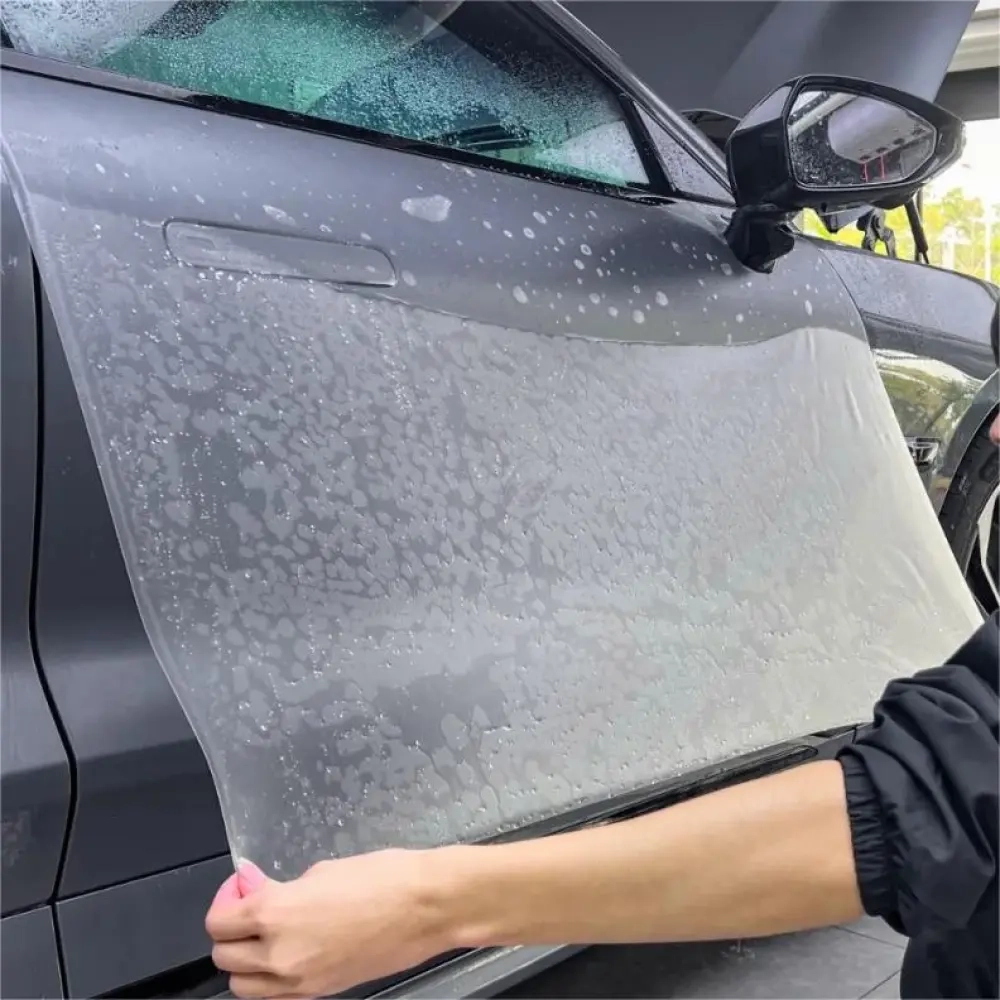
This guide focuses on wet install PPF best practices, including proven slip/tack mix ratios, a step-by-step pro workflow, and measured performance data you can reference when selecting materials and setting customer expectations.
Why choose a wet install?
Paint protection film (PPF) is a clear, aliphatic TPU film engineered to absorb chips, scuffs, and environmental fallout while preserving OE paint. A wet install lets the film “float” for precise alignment on complex curves, reduces trapped air, and minimizes marring because the squeegee glides on a lubricated surface. Modern PPF adds self-healing topcoats and high-gloss clarity; matte and colorized options expand styling without repainting.
Tools & mix ratios that work
- Slip solution (for positioning): Neutral soap 2 mL per 1 L of water. Do not add alcohol to the slip. Mix fresh daily.
- Tack solution (for edges, corners, anchors): Two common mixes work well:
- 99% IPA 150 mL + water 850 mL (1 L total)
- 70% IPA 250 mL + water 750 mL (1 L total)
- Environment: Aim for 16–30 °C (ideal 21–26 °C), dust-free, with soft lighting.
- Tools: Clay bar, lint-free towels, sharp 30° blades, flexible & rigid squeegees with wet edge buffers, steamer or heat gun, spray bottles or pump tanks.
Step-by-step wet install workflow
- Prep: Wash, decontaminate (clay), then degrease with isopropyl alcohol. Dry with lint-free towels.
- Flood: Generously spray slip on the panel and on the film’s adhesive immediately after liner removal to minimize static and dust.
- Position: Float the film into place. If needed, create a small “dry anchor” zone to keep alignment from drifting.
- Squeegee: Start from the center and work outward in overlapping 50% strokes, keeping the surface wet so the buffer glides without marring.
- Conform: For deep curves and recesses, add gentle heat (steam 30–50 °C) while maintaining even tension. Avoid overstretching; use relief cuts where necessary.
- Edges: Flush away residual soap under edges with clean water; then use tack solution to lock them. Wrap and re-squeegee critical zones.
- Finish: Trim with a sharp blade (light scoring only). Re-squeegee edges and body lines. Allow 24–48 hours before washing.
Measured performance benchmarks (typical 8–8.5 mil PPF)
Use the following baseline data when communicating results and setting workmanship standards. Values depend on brand and construction, but modern TPU PPF commonly meets or exceeds these ranges:
| Property | Typical Value / Range | How it’s measured |
|---|---|---|
| Nominal thickness (w/o liner) | ~7.6–8.0 mil (≈ 193–203 µm) | Product TDS; micrometer check |
| Specular gloss (gloss film) | >90 GU @ 60° | ASTM D523 glossmeter (60°) |
| Tensile elongation @ break | >300 % | ASTM D882 tensile test |
| Ultimate tensile strength | >15 MPa | ASTM D882 tensile test |
| Peel adhesion (24 h) | >4 N/cm | ASTM D3330 / PSTC 101 |
| Chip/gravel impact | Pass; no detrimental effect | SAE J400 / ASTM D3170 |
| Self-healing topcoat | Light marring heals with heat | Manufacturer functional spec |
Benchmarks above consolidate current PPF technical data and standard test methods so you can spec materials confidently and explain outcomes to clients.
Pro tips & QA checklist
- Mix slip exactly (2 mL/L) and keep both sides of the film wet while squeegeeing to avoid mars.
- Use tack solution sparingly for corners/edges; flush residual soap from edges before tacking to avoid lift-back.
- Overlap strokes by ~50% and re-squeegee body lines and edges after trimming.
- In hot bays, increase soap slightly in the slip to maintain glide; in cool bays, allow extra drying before trimming.
- Post-inspect after 24 hours for micro-bubbles; many evaporate naturally, but evacuate any persistent moisture pockets.
Choose your finish & coverage
Whether you’re protecting a daily driver or building a show car, select the film that fits the brief:
- car wrap — plan partial vs. full coverage and panel order before cutting.
- gloss ppf — maximize depth and reflectivity with high-clarity gloss films.
- matt ppf — achieve a refined satin/matte look while hiding minor swirls.
- colored ppf — add design impact with color while retaining chip protection.
Blog comments
0 Comments