

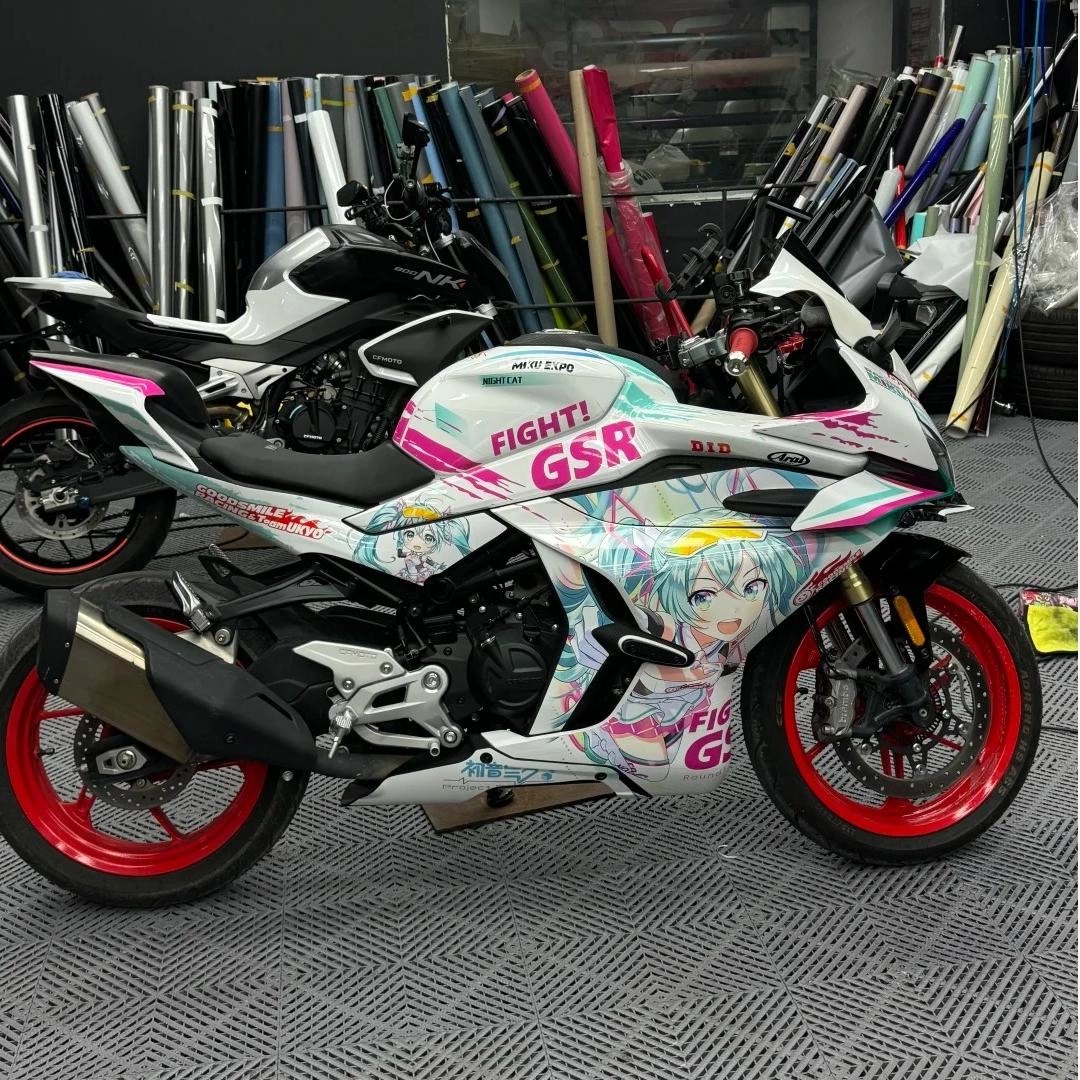
An anime car wrap turns daily driving into rolling art. Whether you’re showcasing a favorite character, a studio-style collage, or original fan art, success depends on three things: clean design, the right film, and a pro-level install. This guide walks you through the full process—from concept to care—so your wrap looks crisp, lasts longer, and draws the right kind of attention. If you’re new to wraps, start with our overview of car wrap options.
Step 1 — Lock the Concept & Prep the Files
Begin with the story: are you going full character panel on doors, a hood mural, or a subtle livery that hides references in the pattern? Decide what must be legible at 2–3 meters (logos, eyes, key motifs), then simplify supporting textures so they don’t fight the main art. For mixed media, keep logos, type, and sharp linework as vectors, and use high-resolution raster for illustrations.
Working size & resolution
Build your layout at full scale whenever possible, and aim for design files that keep fine edges clean when viewed from arm’s length. Vector elements (logos, line art) are ideal; for images, prepare high-quality exports and proof at actual size on a test panel before committing to print.
Color management & proofs
Convert art to print-ready CMYK, define spot colors for any brand hues, and request a printed proof strip on the same vinyl/laminate you’ll use for the car. Anime palettes often contain saturated neons and deep shadow gradients—proofing helps you avoid crushed blacks or oversaturated reds.
Legal & licensing
Use original artwork or properly licensed assets. Fan art still needs permission if it depicts protected characters or marks. If in doubt, commission an artist and obtain usage rights in writing.
Ready to design with our team? Explore custom vinyl wrap services.
Step 2 — Choose the Right Vinyl & Finish
For complex curves, deep channels, and long-term outdoor use, premium cast wrap films are the standard. They’re thinner, more conformable, and hold shape over time—ideal for large character art crossing door gaps and bumpers. Calendered films can work on flatter panels or short-term promos but are less conformable for intricate vehicles.
Pick a laminate that matches the look and protects the print. Gloss makes colors pop (great for bold anime palettes), while matte reduces glare and gives a poster-like vibe. Start here for surface choices: gloss vinyl wrap and matte vinyl wrap.
Step 3 — Budget the Project (Realistic Costs)
Pricing varies by vehicle size, film grade, design complexity, and installer experience. Expect a full-vehicle anime car wrap to fall within a broad national range; complex multi-panel prints, extensive disassembly (mirrors, handles, trims), and meticulous edge finishing push costs higher. Material choice (premium cast film with a quality overlaminate) improves durability and color fidelity and is worth the upgrade for character-heavy art.
- What influences price? Vehicle size/complexity; panel breaks; recessed areas; premium film/laminate; design time; extra prep (paint correction, badge removal); aftercare kits.
- Ways to optimize: Reduce micro-details in door gaps; group colors efficiently; avoid tiny text on curved areas; keep critical faces/features on the flattest panels.
Step 4 — Installation Basics That Protect Your Art
Quality installs happen in a clean, climate-controlled bay. Pro shops will deep-clean panels, remove badges/trim as needed, “float” large panels for alignment, and use controlled heat to conform film into curves without over-stretching. Printed wraps are always applied dry (no soap-and-water wet methods) to ensure proper adhesion. Overlaps between multi-panel graphics are typically kept small and consistent for a near-seamless look.
Edge security & post-heating
After the film is conformed, the installer post-heats stretched areas and edges to lock memory. This step reduces lift in door cups, bumper channels, and tight curves, and it’s critical for long-term durability—especially on character features placed across complex shapes.
Step 5 — Timeline & Aftercare
From drop-off to pick-up, most full wraps are completed within a couple of days at reputable shops, with additional time for complex designs, panel curing, or reassembly. Give the vinyl 24 hours before washing. Hand-wash is best; touchless washes are acceptable, but avoid brushes, high-pressure jets at edges, and harsh solvents. Park under cover when possible to preserve color vibrancy for years.
Pro Tips for Anime Artwork That “Reads” on the Road
- Scale for distance: Make faces and key motifs read at 2–3 m. Use larger, simpler shading on high-curvature parts.
- Hide the seams: Keep crucial eyes/mouths off door gaps and bumper splits; shift them to larger flat panels (hood/doors/quarters).
- Contrast over complexity: Use bold value separation instead of ultra-fine hatching that can soften at print scale.
- Proof smartly: Print a 24–30 cm test strip that includes skin tones, hair highlights, and line art to confirm color and edge crispness.
- Future refresh: Design modularly (separate hood/roof graphics) so you can update arcs or add limited-edition panels later.
Have questions about film choice, artwork prep, or scheduling? Our team can advise and quote options that balance impact, durability, and budget across full and partial car wrap packages.
Blog comments
0 Comments