

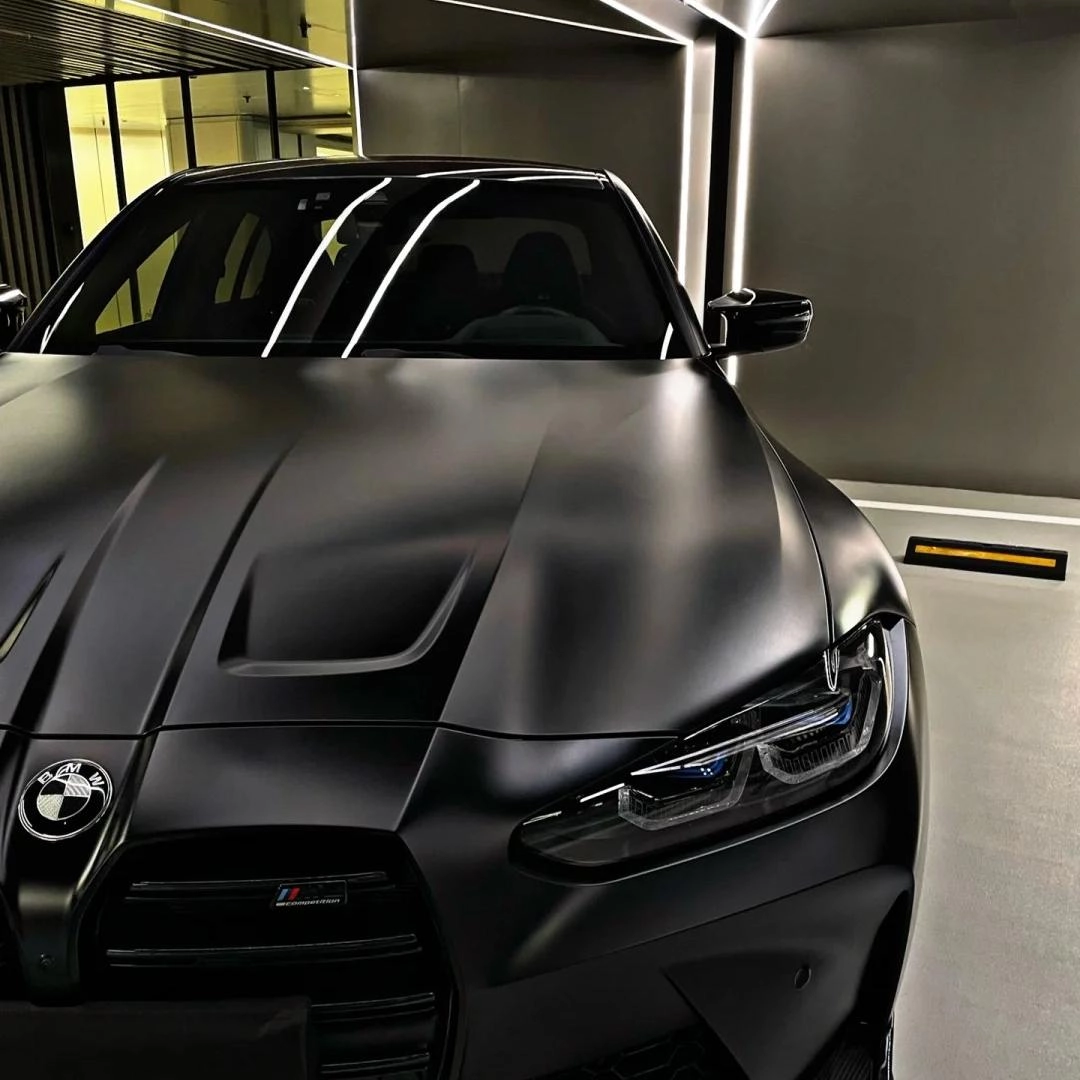
Few finishes communicate modern minimalism as clearly as the matte black color. Whether you’re designing a stealthy performance car, a non-reflective camera rig, or a showroom fixture that lets products stand out, matte black remains the go-to neutral for control, contrast, and durability. This guide breaks down how matte black works at a material level, where it’s most effective, and how to choose the right film specifications when you’re shopping for a premium wrap.
What “Matte Black” Means in Practice
Color appearance is driven by both pigment and surface texture. Matte surfaces use micro-texture to scatter incident light, dramatically lowering specular reflection. In coating and film terms, “matte” typically indicates low gloss measured at 60°—often in the single-digit gloss units (GU). Because specular highlights are suppressed, the perceived black looks deeper and more uniform under diverse lighting (studio softboxes, overcast daylight, garage fluorescents) and is less prone to distracting glare than satin or gloss.
In color spaces such as CIE L*a*b*, black targets a low L* (lightness) value. The micro-roughness of a matte surface helps maintain that low lightness visually by diffusing hot spots that would otherwise brighten the appearance. The result is a “velvet” black that emphasizes edges and panel breaks without the mirror-like reflections found on glossy finishes.
Why Designers Choose Matte Black
- Visual control: Reduces glare in studios, showrooms, and outdoor events.
- Silhouette & form: Highlights panel geometry and negative space rather than reflections.
- Perceived precision: Matte reads as technical and deliberate, pairing well with brushed metal, carbon textures, or muted accents.
- Contrast: Logos, badges, and colored graphics pop against a neutral, reflection-free field.
Automotive Applications: Choosing the Right Film
Wrapping is the most flexible route to a matte black transformation because you can install, remove, or refresh without repainting. If you’re exploring a full vehicle or targeted accents (roof, hood, mirrors), start with a quality vinyl wrap designed for exterior use.
Finish options: matte vs. satin
Matte black wrap minimizes gloss to maximize shape and contrast; satin black introduces a subtle sheen that’s easier to wipe down and slightly more forgiving on daily drivers. Both can be layered with paint-protection strategies on high-wear zones if desired.
Cast vs. calendered construction
For complex curves and deep channels, a cast construction provides superior conformability and long-term dimensional stability. If your brief calls for premium cast choices, review curated lines of casting black wrap options engineered for professional installs and clean removability within the rated service life.
Thickness, adhesive & install
Automotive matte black films are commonly in the ~3–4 mil range (base film + adhesive + topcoat) with air-release channels to reduce bubbles. Repositionable adhesives allow panel alignment before squeegee pressure commits the bond. Use controlled heat for stretching into recesses; avoid over-stretching on sharp returns to preserve texture and color uniformity.
Durability, care & touch-ups
With proper prep and aftercare, quality films deliver multi-year service on daily-driven vehicles. Hand wash, avoid automatic brushes, and consider a matte-safe sealant to reduce road film adhesion. For edge lifting or stone nicks, localized re-work is straightforward compared to respraying paint.
Ready to compare shades and textures? Explore category-wide options for a full-body black car wrap, or zero in on dedicated matte lines tailored for stealth builds.
Beyond Cars: Product, Interior, and Exhibit Design
The same physics that make matte black effective on vehicles translate to rigs and environments where glare control matters. In product photography, a matte black surface prevents unintended specular spikes near subject edges. On fixtures and display plinths, it recedes visually so merchandise commands attention. In interiors, matte black accents (railings, lighting housings, switch plates) create crisp outlines without telegraphing fingerprints the way high-gloss piano blacks can.
Design Impact & Pairing Strategies
- Monochrome depth: Combine matte black with charcoal and graphite to build layers of dark-on-dark without reflections collapsing the palette.
- Material contrast: Pair matte black with satin metals (aluminum, titanium) or dry carbon for a technical aesthetic.
- Accent color discipline: Small, saturated accents (cerulean, signal yellow) read cleaner on matte black than on glossy black because there’s less visual noise from reflections.
- Brand elements: Spot-gloss decals or metallic emblems pop dramatically on a matte field, enabling subtle but high-end branding.
Specification Checklist (Copy/Paste for Quotes)
- Finish: True matte black (low GU at 60°); uniform texture without “sparkle.”
- Construction: Cast film for complex panels and long-term stability.
- Thickness: ~3–4 mil total (incl. adhesive/topcoat) for exterior wraps.
- Adhesive: Pressure-activated with air-release; repositionable; residue-free removal within rated life.
- Conformability: Engineered for channels/curves; controlled-heat application.
- Service life: Exterior-rated; confirm climate-specific expectations with your installer.
- Care: pH-balanced wash; matte-safe sealant; microfiber only.
Where to Start
If your project calls for a refined, glare-free aesthetic with maximum control over reflections, matte black is the benchmark. Begin with a hood or roof test panel to validate texture and cleanability, then proceed to a full vehicle or fixture set using a premium vinyl wrap. For the most demanding curves and long-term stability, shortlist cast constructions from curated casting black wrap selections, or browse all-black families if you’re deciding between true matte and satin across your black car wrap build path.
Blog comments
0 Comments